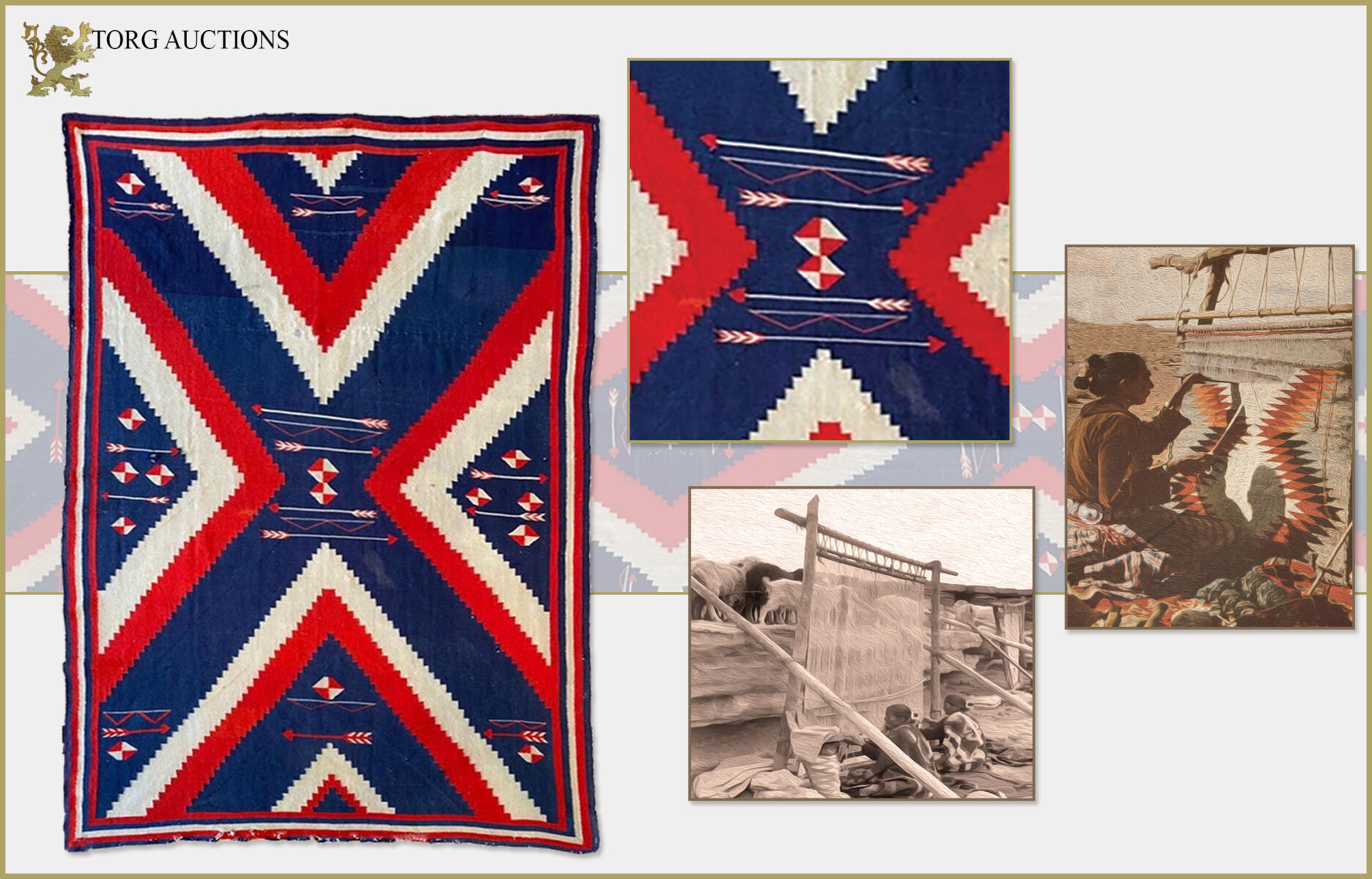
LOT no. 0151 – an Extremely Rare Navajo Blanket/Rug With Confederate Flag Influence. Circa 1870. Featuring in the TORG AUCTIONS SALE: ‘Decorative Antiques Oriental Rugs and Textiles’ 28 May 2023
This unique and striking Navajo Native American piece was woven in the Transitional Period of 1870 to 1900. Here, the Confederate influence dominates the pattern and colours of this weaving, with Native American symbolism depicted by arrow motifs woven throughout this highly desirable piece. The colours are striking and bold, with saturated reds, clear ivories and deep-navy blues, all woven in repeating patterns of diamonds with stepped (serrated) edges, with crosses and American flag influences. Here the ‘Germantown’ wool is hand-woven on a cotton weave foundation. There are only a few similar pieces currently in existence, where this wonderful weaving is considered a ‘museum piece’ among Navajo Weaving Specialist Collectors.
The Diné – meaning ‘The People’ in their language, but also known worldwide as ‘Navajo’ Native Americans – have a long history of weaving traditions, using the soft, silky wool of their uniquely-bred Churro sheep.
This striking rug is not only a work of art, but also a testament to the displacement, struggles and hardships the Diné endured, and the resilience and subsequent transformation tthey underwent, during and after the American Civil War. As the war escalated, the Diné way of life and nomadic traditions were deeply affected and many were displaced by the warring factors.
From 1863 to 1866, more than 9,000 Diné were made to abandon their homes, centred around Canyon de Chelly in eastern Arizona, and subsequently marched approximately 400 miles to an internment camp in Bosque Redondo, New Mexico, to specially constructed reservations advocated for their safe-keeping. This journey became known as the ‘Long Walk’, where over 3,000 children and adults perished due to exposure, disease or starvation along the route, as they walked from fort after fort along the route, until they reached Bosque Redondo.
Once there, the government issued Mexican blankets that were handed out among the displaced diaspora to provide warmth and protection. The strong geometric shapes and bright colours of these ‘eye dazzler’ woven blankets inspired the Diné weavers and artists. These weavings were often referred to as ‘Germantown pieces’ having been woven in commercial mills in Germantown, Pennsylvania, where the wool yarn was coloured using synthetic dyes, which imparted a broader range of colours than the natural dyes Diné weavers had traditionally used.
During the Transitional Period, the Diné People returned to a reservation carved out of their traditional homelands. However, due to the seizure of Diné land and livestock during the Civil War, they were no longer able to rear and breed the sheep that had traditionally been their source of meat, wool and trade.
The government of the time henceforth agreed to provide ‘Germantown’ wool for the Diné people to continue their livelihood of weaving blankets and rugs, as part of the terms of their peace treaty and annual annuity payments. Here, Diné weavers began applying the bright commercial dyes to their hand-spun wool or using the brilliantly coloured commercial yarns, thereby producing eye-catching weavings for sale. These pieces often depicted geometric patterns and designs – influenced by the original Mexican eye dazzlers and also included variations of the American flag symbol to increase their appeal to non-Indigenous buyers, which proved very popular at commercial trading posts.
This rug is a woven record of that time and place, where the Diné peoples’ resilience and fortitude overcame tremendous difficulties, to produce beautiful, iconic weavings that are now collected worldwide.